|
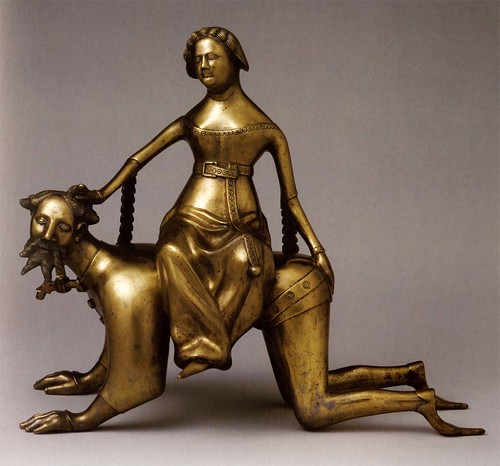
| Ubu Roi, the original 'Pataphysician. |
In a previous post, I discussed the concepts of Crisis Energy and Probability Mining as well as putting forth my theory on magic on a more unified scale. While I argue that all spellcasters are, one way or another, harnessing Crisis Energy and Probability Mining, I believe there are those who act on this in a more active rather than passive role. Your standard Wizard is something of a magical layperson, they know enough to make a thing work and perhaps have read a few guides. Perhaps they got their B.A. of Thaumatology at the local community Wizard's Tower, but wisely realized that wizarding was not exactly a profitable enterprise and oh gods how am I ever going to pay these student loans back. For better for for worse, the 'Pataphysician is a Wizard who went the B.S. route and decided to go back for more schooling. Spell-Ferrets are lies for children to make understanding more easy, 'Pataphysician understand that the more you know, the less sense it all makes. These are the sort of folks who, when told of Quantum Mechanics, ask where the Quantum Engineers are.
 |
| This, just its organic and its actually your brain. art by Justin Oaksford |
School:
Drawback: Your constant exposure to Crisis Energy and manipulation of Probability makes it hard for reality to keep track of which you is you. Every day reroll your race on your GM's favorite random table.
Cantrips:
1: You can make a flipped coin land on any side. Heads, Tails, Side, Bicep, Liver, Castle, Ursa Major...The coin reverts to its normal shape when it is out of sight.
2: If something is inside of a box, you can tell with absolute certainty if it is alive or not without looking inside.
3: You can put one thing the size of a grapefuit into quantum stasis. While not exactly locked in time, this causes the target to always flow on the path of Probability where it doesn't rot, age, or otherwise decay. It can still be damaged by other means though.
 |
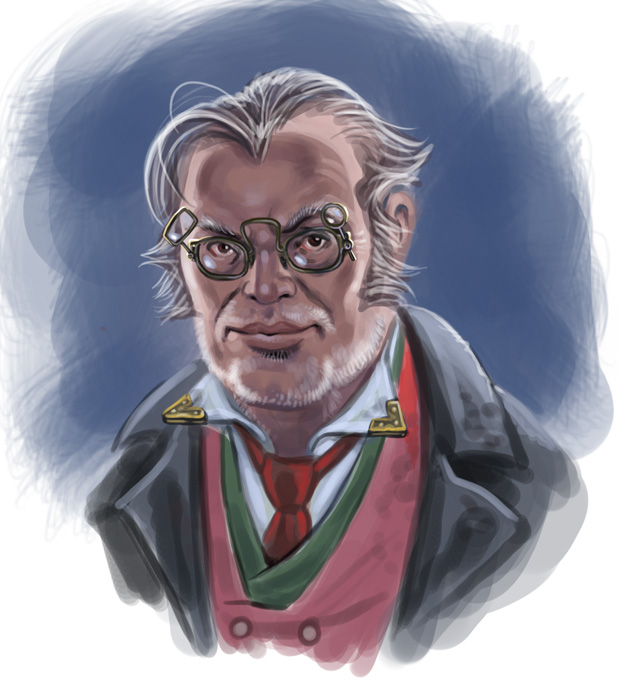
| David Mattingly's Subway Wizard. Because why not? |
1 What if this was a different game?
R: 0 T: self D: [sum]/2 rounds or until expended
On the caster's next roll, instead of rolling for success do the followed based on invested MD:
1: Odds or Evens
2: Rock-Paper-Scissors
3: Rock-paper-scissors-spock-lizard
4: Morra
The caster can also choose to invoke best two out of three, three out of five, or four out of seven for an invested [dice]. Ex. Invest 4 [dice], choose Rock-Paper-Scissors, can play to Three out of Five with remaining two invested [dice].
2 What if I just kept moving?
R: Touch T: creature D: [sum] rounds
As long as the touched creature continues to move, any projectile shot at them will not reach them, as it will continuously have to reach the halfway point between their point of origin and their target. The number of dice invested increases size of projectiles effected:
1: Sling Stones
2: Arrows/Bolts
3: Spears/Javelins
4: Boulders
3 What if pain really was just weakness leaving the body?
R: Touch T: creature D: [dice] rounds
Touched creature gains Defense equal to 20-current HP but not exceeding [sum].
4 What if they picked up the wrong weapon?
R: 30 T: 1 weapon per [dice] D: [sum] rounds.
Severity of change depends upon [sum]
1-6: A less effective weapon of the same type (-1 to hit or -1 to damage)
7-12: A vastly inferior and possibly very different weapon (half damage, swords become blunt sticks or the like)
12-15: An almost totally nonlethal object (weapon damage becomes 1d1)
>16: Something potentially harmful to the wielder, like a runny glob of molten metal or an irate badger (1d6 damage, disarmed for duration)
5 What if every possible strike was made?
R: Touch T: 1 weapon D: [dice] rounds, or until discharged
Invest one weapon with the power to become a Possible Weapon. The next attack made with the weapon will branch into every possible strike that could have happened, melding multiple Possibilities into a single fractal Actuality. This spell is affected by the accuracy of the attacker. A critical hit will result in normal critical damage being rolled plus [sum]. A critical miss will result in the attack branching into a sphere of mishaps, doing damage+[sum] to the attacker and everything within range, friend and foe alike. Just passing the target's defense, however, will create a cone of attacks dealing damage times [dice].
6 What if you can only arrive, by first bridging half of the remaining distance?
R: 60' T: [Sum]/2 HD Creature D: [dice]*2 rounds, or until discharged
Targeted creature is unable to come closer than half the starting distance between itself and the caster, thereby continuously keeping it out of melee range. The caster, in turn, also cannot move closer than half the starting distance to the target. The caster may attempt a Strength check to forcibly move closer, thereby ending the spell early.
7. What if God were one of us?
R: Across the table T: The GM D: Until the GM can say Joan Osborn or [sum] rounds, which ever comes first
A nerdy human in a logo tee manifests next to the caster. They possess completely average human stats and is considered a level 1 monk. The human will react as appropriate to the situation and has a morale of 2d6-2. For each ration that is given to the human that could conceivably be considered junkfood, they gain 1 HD, +1 Attack, and +1 Defense up to [dice]*2. The player who casts this spell is responsible for paying for pizza next session.
8. What if THA0 was still a thing?
R: 100' T: Party + [sum] HD creatures D: [dice]*2 rounds
All Defense (AC, THAC0, DEF, etc.) stats are swapped to their opposite on a d20. Thus 1 becomes 20, 20 becomes 1, etc. In the case of actually using THAC0, add 20 to Negative Defenses,.
9. What if I had chosen a different profession?
R: - T: The Party D: [Sum] Rounds/ Permanent
The caster's player places their character sheet in the middle of the table and everyone else passes their sheets to the left. All players retain their character's basic identity but are now defined by their new character sheet. One player will be without a sheet, this is because the choices made by the caster in their altered youth resulted in that character's demise. Characters have refreshed HP and MD but revert to previous status when the spell is complete. Investing 4 or more MD makes this spell permanent.
10. What if you strapped buttered bread to a cat?
R: 30' T: 1 [sum] HD Creature D: [dice]+2 rounds
Targeted creature flung 30' into the air and begins to spin in place at a high velocity. For the duration of the spell, the creature is unable to orient itself or move from its position and any attempt at an attack targets a random area around the creature. Target takes appropriate fall damage when the spell is complete and is nauseated for a number of rounds equal to the the number of rounds spent in the air.
Emblem 6 What if you can only arrive, by first bridging half of the remaining distance?
R: 60' T: [Sum]/2 HD Creature D: [dice]*2 rounds, or until discharged
Targeted creature is unable to come closer than half the starting distance between itself and the caster, thereby continuously keeping it out of melee range. The caster, in turn, also cannot move closer than half the starting distance to the target. The caster may attempt a Strength check to forcibly move closer, thereby ending the spell early.
7. What if God were one of us?
R: Across the table T: The GM D: Until the GM can say Joan Osborn or [sum] rounds, which ever comes first
A nerdy human in a logo tee manifests next to the caster. They possess completely average human stats and is considered a level 1 monk. The human will react as appropriate to the situation and has a morale of 2d6-2. For each ration that is given to the human that could conceivably be considered junkfood, they gain 1 HD, +1 Attack, and +1 Defense up to [dice]*2. The player who casts this spell is responsible for paying for pizza next session.
8. What if THA0 was still a thing?
R: 100' T: Party + [sum] HD creatures D: [dice]*2 rounds
All Defense (AC, THAC0, DEF, etc.) stats are swapped to their opposite on a d20. Thus 1 becomes 20, 20 becomes 1, etc. In the case of actually using THAC0, add 20 to Negative Defenses,.
9. What if I had chosen a different profession?
R: - T: The Party D: [Sum] Rounds/ Permanent
The caster's player places their character sheet in the middle of the table and everyone else passes their sheets to the left. All players retain their character's basic identity but are now defined by their new character sheet. One player will be without a sheet, this is because the choices made by the caster in their altered youth resulted in that character's demise. Characters have refreshed HP and MD but revert to previous status when the spell is complete. Investing 4 or more MD makes this spell permanent.
R: 30' T: 1 [sum] HD Creature D: [dice]+2 rounds
Targeted creature flung 30' into the air and begins to spin in place at a high velocity. For the duration of the spell, the creature is unable to orient itself or move from its position and any attempt at an attack targets a random area around the creature. Target takes appropriate fall damage when the spell is complete and is nauseated for a number of rounds equal to the the number of rounds spent in the air.
11. What if everything were different?
R: 1 Mile Radius T: [sum]*[dice] Creatures, Terrain D: Permanent
The caster permanently transposes another reality on top of this one in a 1 mile radius area. The terrain is randomly changed to: 1. Forest 2: Marsh/Swamp 3. Desert 4. Taiga 5. Steppe 6. Mountains. All animals within the area are transformed into creatures appropriate to the new biome. All sentient humanoid creatures in the area (including the caster and their allies) are changed to a random new race (use the GM's favorite race or resurrection table). Inherently magical or unique creatures may be unaffected or may be allowed a Save vs. Death to resist the effects.
12 What if the cat were alive AND dead?
R: Touch T: [sum] HD Creature D: [dice] rounds
Touched creature enters a state of quantum uncertainty, appearing as many dozen versions of the creature overlayed on top of one another. While in this state, any rolls made by the creature act as though they made the worse possible, best possible, and median result and take any associated consequences therein. If the result is truly paradoxical, like both successfully climbing a wall and also falling off of it, all observers must Save vs. Spell. If more observers fail than succeed, the target acts as though failed and visa versa. Furthermore those who failed the saving throw take 1d6 damage while their brain has a mild hemorrhage.
 |
| Admittedly, Moondog was more of a Bard than a Wizard, but he looked the part! |
Mishaps:
1. Take 1d6 damage as reality backhands you.
2. Reality has misplaced your instructions. You are incorporeal and stunned for 1d6 rounds as everything is sorted out.
3. You become overwhelmed with all the Possibilities before you, act as blinded for 1d6 rounds.
4. Spell goes into Crisis Overload. Spell recasts itself repeatedly at closest valid target until all magic die are used up.
5. Reality calls for a do-over. Reroll Magic Die for spell, take the less advantageous result.
6. Random mutation for 1d6 rounds, then make a save. Permanent if you fail.
Dooms:
1. You become aware that you are a character in a game being controlled by someone who, undoubtedly, does not have an 18 Int. Any time anyone at the table calls your actions into question, you have a 50% chance to loose that action as your player struggles with story logic vs. metagame logic.
2. Somewhere out there, there is a you who has only made bad decisions. This is now you. Reroll, in order, 4d6 for each of your stats, dropping the highest.
3. You've become so unstuck from fate and probability that reality decides it is far better off without you. You not only no longer exist, you never have and never will in this or any other reality. Time/Space adapts accordingly. Hand the GM your sheet and a lighter. Remember, this is your fault.
To avoid this fate, you must become self referential (such as becoming your own grandfather) or ascend to being an Ontological Truth, so bound to the foundation of reality that you might as well be Gravity or electromagnetic radiation. I suggest killing a true King and taking their place.
 |
| This guy knows what's up. |
Thoughts
I don't know man. This was one of the first posts I started up when I made this blog and I just needed to get it of my drafts. It is weird and probably unbalanced and messes with meta and 4th wall a lot. I will eventually make a better 4th wall class. Consider this a combination of practice and a remember to myself how the Snake Wizard is absolutely a sign of growth since originally coming up with this class.